AI Music Is Everywhere. But Is More Music What We Actually Need?
Last updated October 27, 2026.
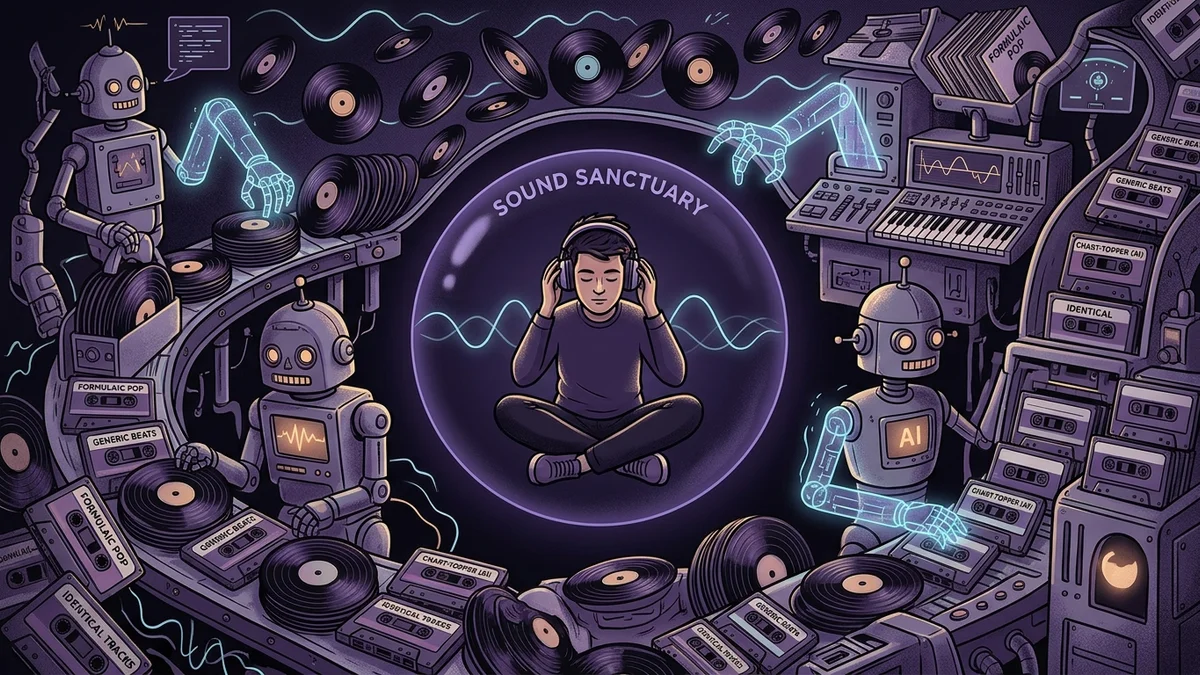
The music tech industry treated generative AI as a high-speed factory to manufacture songs and flood public catalogs. But listeners don’t suffer from an art shortage—they suffer from decision fatigue. The real breakthrough of AI in audio isn’t generating another infinite queue of three-minute songs; it’s providing adaptive sound that supports your mental state without demanding your attention.
The Paradox of Abundance
Generative AI audio models have achieved something technically staggering. Tools like Suno and Udio can ingest a 10-word prompt and output a radio-ready pop track, complete with verses, hooks, harmonies, and synthetic vocalists, in under thirty seconds. A listener on the subway cannot reliably tell if the bassline was played by a session musician in Nashville or rendered on an NVIDIA cluster.
Yet, something unexpected happened as soon as music became infinite: it became exhausting.
Over 120,000 new tracks are uploaded to commercial streaming services every single day. Spotify recently filtered over 50 million AI-generated tracks from its curated recommendation feeds simply to protect listeners from drowning in synthetic filler. When making music costs nothing, the catalog becomes a landfill.
This points to an underexplored question: What if the least interesting thing AI can do for music is generate more songs?
The Category Error: Art vs. Acoustic Utility
The tech industry's obsession with "AI pop stars" stems from a fundamental category error about why human beings listen to sound in the first place.
When you put on headphones, your brain is typically seeking one of two very different experiences:
Artistic Connection & Identity
You want to feel connected to another human being’s lived experience. You care who wrote the lyric, what heartbreak inspired the bridge, and what cultural moment gave birth to the sound.
- Domain: Human musicians (Kendrick, Radiohead, your local indie band).
- Role of AI: Intrusion. An AI simulating vulnerability or grief is just a statistical illusion. Art requires consciousness on the other end.
Acoustic Utility & State Regulation
You don't want a narrative or a persona. You are coding on a deadline, calming your nervous system after a commute, or pushing through the last mile of a run. You need your auditory environment to support your cognition.
- Domain: Adaptive sound, functional audio, mood regulation.
- Role of AI: Superpower. Removing disruptive lyrics, matching ultradian rhythms, and tailoring tempo to your focus.
The mistake of the first generative wave was trying to force AI into Category 1. Listeners don't want a synthetic Taylor Swift. But in Category 2, traditional recorded music consistently fails us.
The 9:00 AM Spotify Tax
Consider the universal modern ritual: It's 9:00 AM on a Tuesday. You sit down at your desk with coffee, open your IDE or writing software, and launch Spotify or Apple Music.
You aren’t looking to discover your next favorite band. You just want something that helps you lock in for two hours of uninterrupted deep work.
What happens next?
- You scroll through dozens of algorithmic playlists labeled "Deep Focus," "Brain Food," or "Lo-Fi Beats."
- Track 1 is great. Track 2 has unexpected jarring vocals that hijack your verbal working memory.
- Track 3 is so lethargic it makes you sleepy. You reach over to skip.
- Now your brain is out of flow, browsing catalog search bars instead of solving your problem.
This is the Paradox of Choice: having access to 100 million recorded songs was designed for active music appreciation, not for sustained cognitive productivity. A static album recorded in 1998 was never engineered to adapt to your 90-minute ultradian attention cycle.
What If Sound Worked for the Listener Instead?
Instead of treating AI as a synthetic composer trying to win a Grammy, what if generative audio worked as quiet cognitive infrastructure?
This is the philosophy behind Noema. We didn't build Noema to replace working musicians or construct virtual pop icons. We built an AI-powered radio experience centered entirely around the listener’s state of mind.
| Dimension | Catalog Streaming (Spotify / Apple) | Prompt Generators (Suno / Udio) | Adaptive Audio Radio (Noema) |
|---|---|---|---|
| Interaction Model | Search, browse, construct playlists | Type text prompts, wait, review takes | Tap a mood (Focus, Relax, Workout) & press play |
| Audio Format | Fixed 3–4 minute recorded songs | Discrete generated song files | Continuous, living stream generated in real time |
| Cognitive Load | High (decision fatigue & skips) | High (prompt engineering) | Zero (instant start, no account required) |
| Core Purpose | Commercial catalog distribution | Songwriting and novelty generation | Personal state regulation and flow protection |
In Noema, every track is generated fresh for that station. Because the sound is created on-the-fly rather than pulled from a static catalog, it never repeats, never breaks for licensing takedowns, and never forces you through an ad break when you're in the zone.
Through our Your Frequency engine in Pro, the station quietly pays attention to what you finish versus what you skip, tuning the station’s texture around how your brain actually works.
Does Music Need a "Soul"—Or Do We?
One of the most frequent questions searched on Google regarding generative audio is: "Can an AI song have a soul?"
Philosophers and music theorists can debate that endlessly. But perhaps that question is backwards.
The real question isn't whether algorithmic neural networks possess souls. It’s whether technology enriches or degrades the human soul.
Flooding streaming services with synthetic spam, diluted royalties, and fake artist profiles degrades the human experience. It devalues the hard-won craft of real artists and drowns listeners in noise.
On the other hand, using generative technology to strip away distraction, lower your cortisol after a punishing workday, or help you focus deeply on meaningful work elevates human potential.
We don’t need an infinite number of new AI songs. We already have centuries of brilliant human music to love and cherish.
What we actually need is sound that understands where we are, respects our attention, and helps us live our lives with a little more clarity.
Sources & Further Reading
- Spotify Removed 50 Million AI Tracks from Recommendations: The Filter Is Now the Product — Noema Journal (October 2026)
- If AI Can Make Unlimited Music, Who Decides What You Hear? — Noema Journal (September 2026)
- Ultradian Rhythms and Adaptive Sound: Why Static Playlists Break Deep Work — Noema Journal
- Best AI Music Apps in 2026: An Honest Comparison — Noema Journal
- Schwartz, Barry. The Paradox of Choice: Why More Is Less. Ecco/HarperCollins, 2004.